Last Updated: May 2026.
Underground utilities go in before the foundation is poured on every commercial construction project. Water service, sanitary sewer, storm drainage, natural gas, primary electrical, communications, and under-slab plumbing rough-in all must be installed, inspected, and approved before the slab can be placed. Underground utility cost on a typical East Texas commercial project runs $5 to $18 per square foot of building footprint, with site conditions and tie-in distance driving most of the variation. SYB Builders coordinates underground utility installation as part of every ground-up commercial project across East Texas and the DFW metroplex, and this guide explains what goes in, in what order, and the East Texas soil and water table factors that affect cost and risk.
What Goes Underground on a Commercial Construction Project?
The underground utilities that get installed before the building slab is poured on a typical East Texas commercial project:
- Sanitary sewer service: Gravity sewer from the building to the public main, or to an on-site septic / aerobic system on rural sites. Lift station and pressurized force main where gravity is not feasible.
- Domestic water service: Service line from public main to building. Sized for both potable demand and fire suppression where applicable.
- Fire water service (separate): Dedicated fire service line, typically 6-12 inch DI or HDPE, from public main to building fire room. Includes detector check valve and post indicator valve (PIV).
- Storm drainage: Storm sewer pipe from area drains, curb inlets, and roof drain discharges to public storm system or to on-site detention.
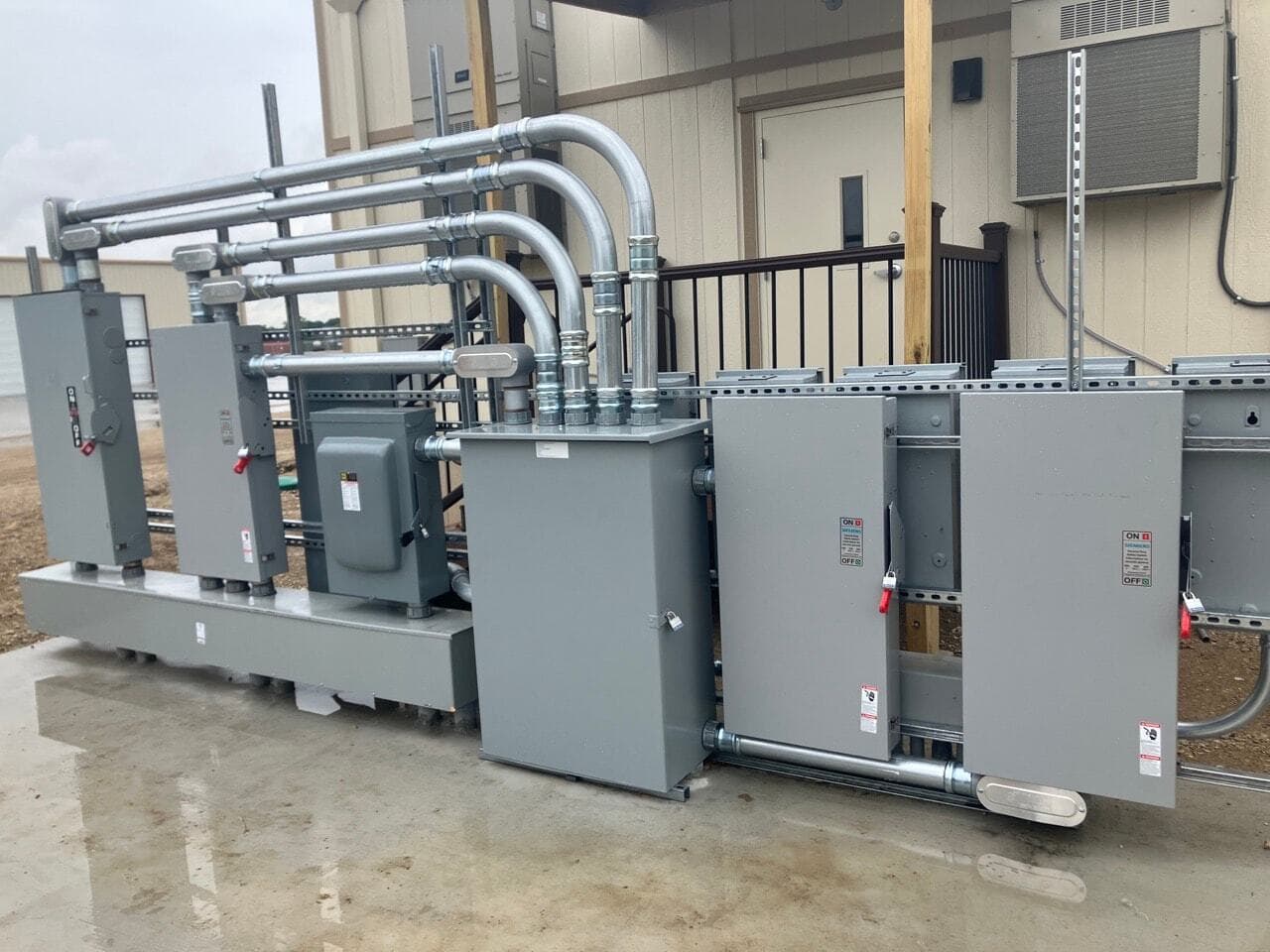
- Primary electrical: Conduit and duct bank from utility transformer pad to building electrical room. Utility-owned beyond the meter point.
- Natural gas: Service line from utility main to building meter set, where natural gas is available.
- Communications: Fiber-optic, telephone, and cable conduit from street to building communications room.
- Site lighting and exterior conduit: Conduit runs for parking lot poles, EV chargers, signs, and security gates.
- Under-slab plumbing rough-in: Sanitary, vent, and water lines that run under the slab to building fixture locations.
- Mechanical sleeves and conduit penetrations: Sleeves through the slab for future plumbing, HVAC, and electrical penetrations.
Each of these has its own engineering, inspection, and utility coordination requirements.
Why Does Underground Utility Work Have to Happen Before the Foundation?
Three reasons make sequence non-negotiable:
- Physical access: Once the slab is poured, you cannot reach what is under it without breaking concrete. Even small omissions become expensive change orders.
- Inspection requirements: Most jurisdictions require sign-off on underground plumbing, electrical, and mechanical before slab pour. Texas plumbing code (and city amendments) require pressure testing of under-slab drainage and water lines before they are covered.
- Design coordination: Plumbing fixture locations, electrical service location, HVAC equipment placement, and structural footings all interact below grade. Coordinating before foundation construction is the only way to avoid conflicts.
A missed under-slab plumbing line can cost $5,000-$25,000 to add after the slab is poured, plus weeks of schedule loss. Disciplined preconstruction and detailed shop drawings prevent these.
What Is the Typical Sequence of Underground Utility Installation?
A representative sequence for a typical East Texas commercial site:
- Site clearing and rough grading
- Mass excavation as needed for the building pad
- Detention pond or underground storm retention construction (if applicable)
- Storm drainage main installation
- Sanitary sewer service tap and main installation
- Water service tap and main installation, including fire service line
- Gas main extension and service stub-in (utility coordination)
- Electrical primary trenching, duct bank, and transformer pad set (utility coordination)
- Communications conduit installation
- Building pad finish grading and lime stabilization
- Drilled pier installation (where applicable)
- Grade beam excavation, formwork, rebar
- Under-slab plumbing rough-in (sanitary, vent, water)
- Under-slab electrical conduit (where required)
- Vapor barrier and capillary break
- Inspection of under-slab plumbing and electrical
- Slab rebar / mesh placement
- Slab pour
This sequence can take 6-14 weeks for a typical 20,000-50,000 sf commercial building, depending on site complexity and utility tie-in distances.
What Does Underground Utility Work Cost on East Texas Commercial Projects?
2026 underground utility costs vary significantly with site conditions. Representative ranges for typical East Texas commercial sites:
- Total underground utilities (water, sewer, storm, gas, electric, comm): $5 to $18 per square foot of building footprint for sites with utilities within 100 feet of property line. Add $25,000-$300,000+ for longer extensions.
- Sanitary sewer tap and main extension: $35-$95 per linear foot for 4-8 inch PVC, plus $3,500-$12,500 for tap-on fees.
- Water service tap and main extension: $45-$135 per linear foot for 6-10 inch DI or HDPE, plus $2,500-$18,500 for tap and meter fees.
- Lift station (where gravity sewer not feasible): $85,000-$285,000 installed depending on capacity and complexity.
- Storm drainage main: $45-$135 per linear foot for typical 18-36 inch RCP or HDPE.
- Detention pond construction: $4-$12 per cubic yard of excavation plus structures.
- Underground stormwater retention (StormTech, etc.): $85-$185 per cubic yard of storage volume.
- Primary electrical conduit and duct bank: $35-$85 per linear foot, plus transformer pad and termination work.
- Natural gas service extension: Highly variable, often included by utility for projects with adequate consumption.
- Under-slab plumbing rough-in: $2.50-$6 per square foot of building footprint.
How Do East Texas Soils Affect Underground Utility Work?
East Texas soil conditions create specific underground utility challenges:
- Expansive clay: The same red and gray clays that cause foundation problems also stress underground utility lines. Plumbing under buildings on expansive clay requires extra care: flexible joints, proper bedding, and adequate cover. Older buildings on East Texas clay routinely experience under-slab plumbing breaks from soil movement.
- Shallow water table: Many East Texas sites have water table within 6-10 feet of grade during wet seasons. Trench dewatering, properly bedded pipe, and corrosion-resistant materials become important.
- Rocky outcrops: Parts of East Texas have limestone, sandstone, or chert outcrops that require rock excavation. Add $35-$95 per cubic yard for rock excavation, plus delays.
- Variable bearing for utility structures: Manholes, lift stations, and large drainage structures require engineered foundations on poor bearing soils.
- Sulfate-bearing soils: Some areas have high sulfate concentrations that require sulfate-resistant concrete and special design for buried structures.
SYB Builders coordinates geotechnical recommendations with underground utility design on every project to address these conditions properly. Read more in our companion guide to East Texas soil and commercial foundations.
What Utility Companies Do You Need to Coordinate With in East Texas?
Underground utility coordination on East Texas commercial projects typically involves:
- Water and sewer: City utility for in-city sites (Tyler Water Utilities, City of Canton, City of Athens, etc.). Rural water supply corporations (e.g., Mineola RWSC, MUD districts) for unincorporated sites.
- Electric: Oncor Electric Delivery serves much of East Texas and DFW. Trinity Valley Electric Cooperative, Wood County Electric Cooperative, and others serve specific rural areas.
- Natural gas: Atmos Energy serves most of the region. CenterPoint Energy serves some areas.
- Communications: AT&T, Spectrum, Suddenlink/Optimum, and various fiber providers depending on location.
- Local stormwater authorities: City and county stormwater management offices for drainage tie-ins.
Each utility has its own design standards, lead times, inspection requirements, and cost-sharing arrangements. Engaging utilities early in the design process — ideally during schematic design — prevents costly redesigns.
What Goes Wrong With Underground Utilities and How Do You Prevent It?
The most common issues SYB Builders sees on East Texas commercial underground work:
- Conflicts between utilities: Sanitary and water lines that cross at the wrong elevation, electric duct banks that conflict with storm drainage. Prevent with disciplined coordinated shop drawings and three-dimensional review.
- Missed under-slab rough-ins: A floor drain or sink rough-in missed during sequence. Prevent with thorough plumbing coordination and pre-pour walk-throughs.
- Tie-in fee surprises: Impact fees, capital recovery fees, and capacity fees that were not in the early budget. Prevent by confirming all utility fees during preconstruction.
- Long-lead utility upgrades: Three-phase electric extensions, water main upsizing, gas main extensions that take months to schedule with the utility. Prevent by engaging utilities at schematic design.
- Failed underground inspection: Improper bedding, missing testing, inadequate cover. Prevent with experienced underground crews and pre-inspection QA.
How Does SYB Builders Manage Underground Utility Work?
SYB Builders self-performs or directly manages underground utility installation on commercial projects across East Texas and the DFW metroplex. Our underground utilities service covers water and sewer service, fire service, storm drainage, electrical and communications duct banks, lift stations, and detention systems. We coordinate with city utility departments, Oncor, Atmos, and the relevant communications providers on every project, and we sequence the work to keep the critical-path slab pour on schedule. Our construction project management service includes utility coordination as a core scope. Request a free estimate or call (903) 560-8330.