Last Updated: May 2026.
For most warehouse, industrial, automotive service, and big-format commercial projects in East Texas and the DFW metroplex, pre-engineered metal buildings deliver lower cost, faster construction, and better lifecycle performance than wood-frame structures. Wood frame remains the better choice for small office, multi-family, and certain retail applications where interior layout flexibility, finish-out aesthetics, and conventional thermal performance matter more than column-free clear spans. SYB Builders has built hundreds of both systems across truck dealerships, warehouses, retail centers, and mixed-use projects in Texas for over 45 years, and this guide compares the two systems head-to-head on the metrics that actually drive commercial owner decisions.
What Are the Fundamental Differences Between Metal Buildings and Wood Frame?
Pre-engineered metal buildings (PEMB) and wood-frame commercial construction are fundamentally different building systems:
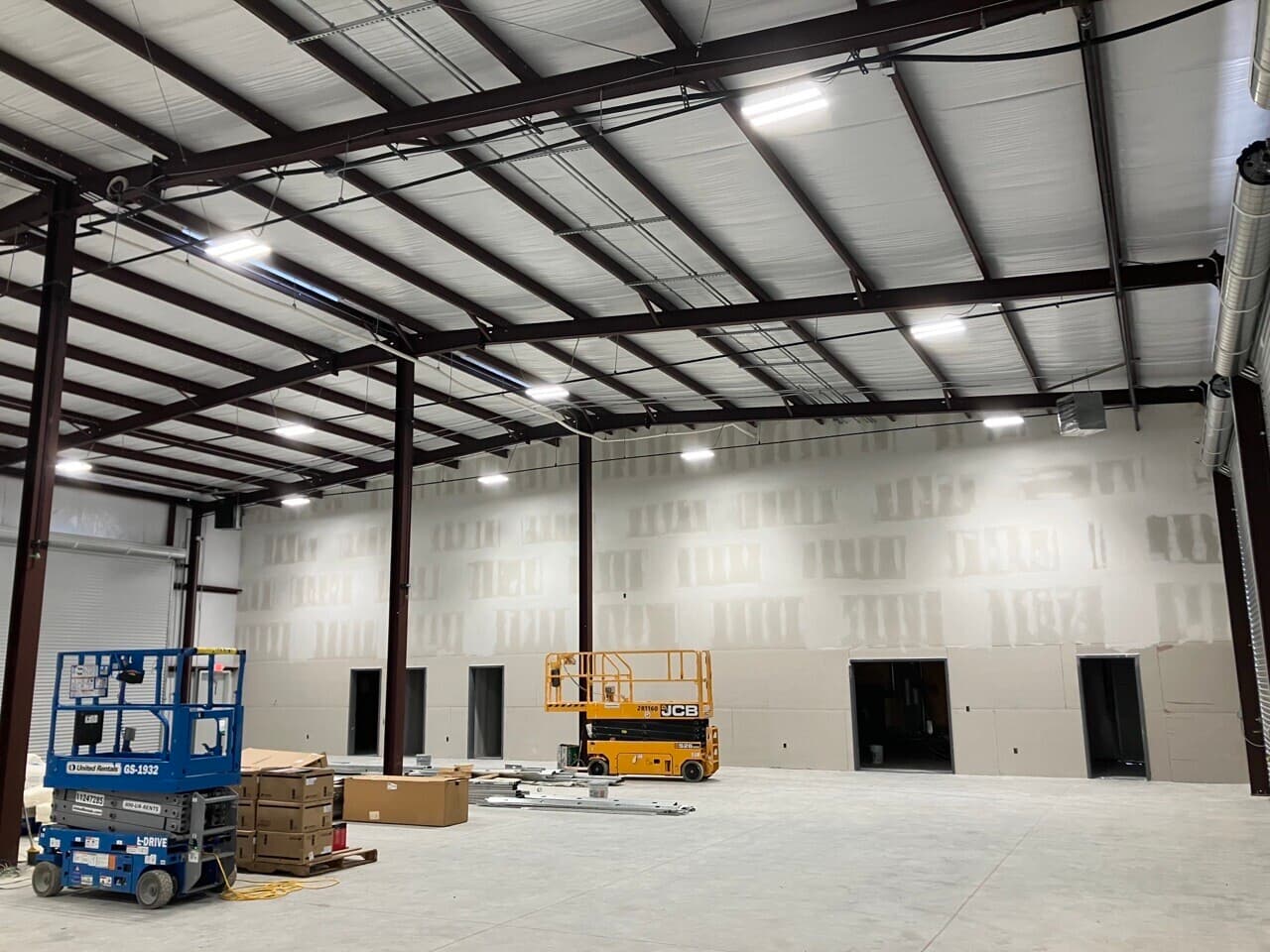
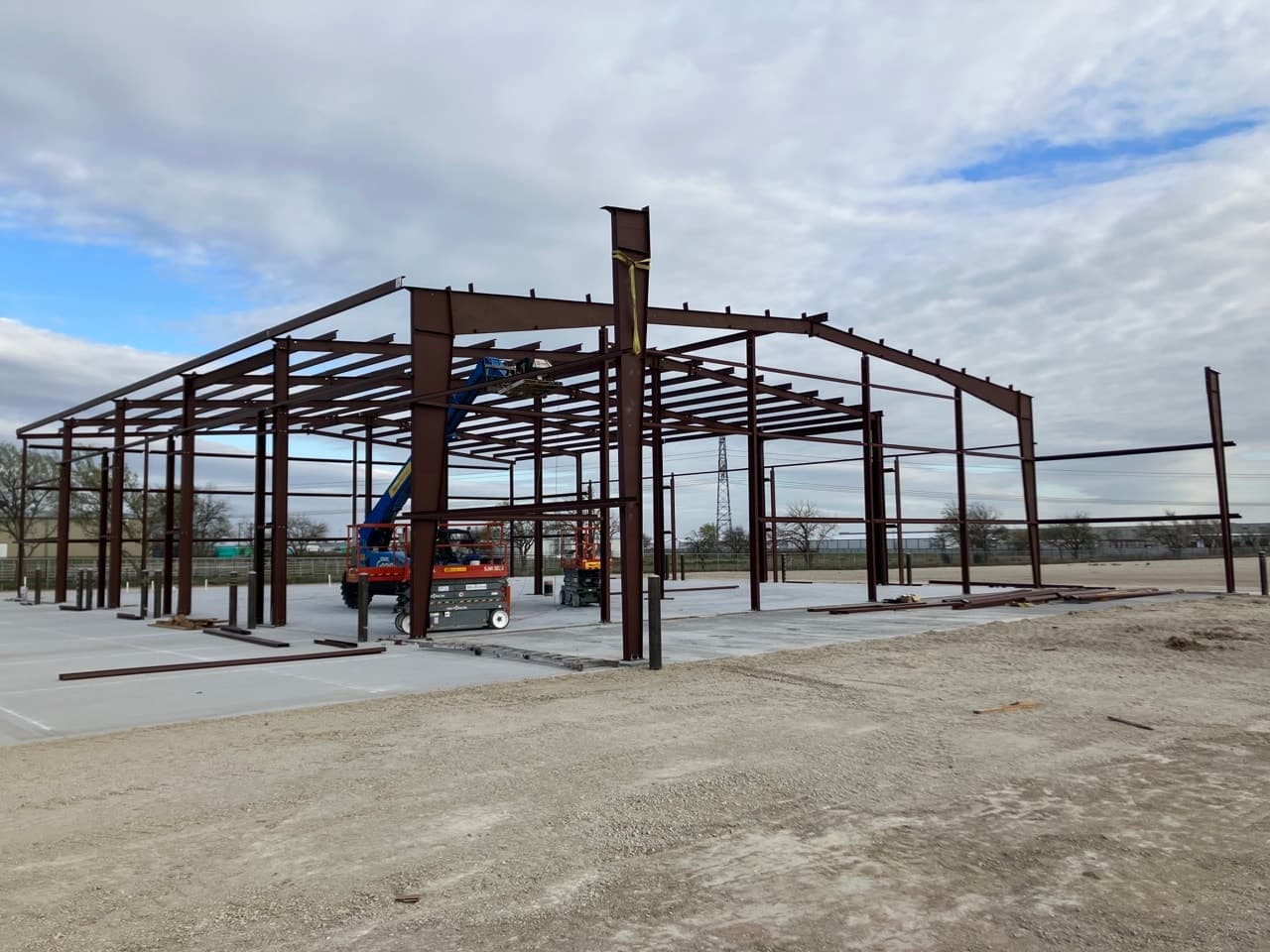
- Pre-engineered metal buildings: Engineered as a complete system by a manufacturer (Butler, Varco-Pruden, Nucor, Mueller, etc.). Primary frame is rigid steel, with secondary steel girts and purlins supporting metal wall and roof panels. Foundations and slab built on-site; building shell delivered as kit and erected.
- Wood-frame commercial construction: Built with conventional wood studs, joists, and rafters or with engineered wood products (LVL, glulam, I-joists). Sheathed with plywood or OSB and clad with conventional exterior finishes. Limited to lower-rise commercial construction by code.
Steel frame (structural steel construction, not pre-engineered) is a third category that overlaps both — used for mid-rise commercial and where conventional construction methods are preferred but wood is impractical.
Metal Building vs Wood Frame: Comprehensive 2026 Comparison
| Attribute | Pre-Engineered Metal Building | Wood-Frame Commercial |
|---|---|---|
| Typical cost per square foot (shell + slab) | $45 - $95 | $65 - $135 |
| Typical turnkey cost per sf (with MEP and finishes) | $110 - $185 | $165 - $275 |
| Design and engineering time | 2-5 weeks | 6-12 weeks |
| Shell fabrication / delivery | 8-16 weeks (factory) | 2-4 weeks (lumber order) |
| Field erection time (20,000 sf) | 4-7 weeks | 10-16 weeks |
| Clear span capability | Up to 200+ feet | Up to ~40 feet conventionally |
| Building height limit | Single story typical, up to 4-story PEMB available | 3-4 stories under IBC (5 with podium) |
| Expected lifespan | 50-70+ years with proper coatings | 40-60 years with proper maintenance |
| Fire resistance | Non-combustible (Type II-B typical) | Combustible (Type V typical) |
| Pest resistance | Excellent — no termite or rodent attraction in structure | Requires ongoing pest management |
| Insurance cost | Generally lower for warehouse/industrial | Often higher for non-sprinklered |
| Thermal performance (envelope) | Depends on insulation system; thermal breaks needed | Conventional cavity insulation works well |
| Expansion potential | Excellent — designed for end-wall expansion | Possible but requires structural redesign |
| Interior layout flexibility | Wide open spans; partitions easily added | Bearing walls and beams limit layout changes |
| Resale value retention | Strong for industrial/warehouse uses | Strong for office/retail uses |
| Best fit | Warehouse, industrial, automotive, big-box, equipment storage | Small office, multi-family, restaurants, boutique retail |
When Is a Pre-Engineered Metal Building the Right Choice?
Pre-engineered metal buildings are the dominant choice for the following commercial applications in Texas:
- Warehouses and distribution centers: Wide-span column-free interior, rapid erection, low cost per square foot. Standard across East Texas and DFW industrial markets.
- Truck and equipment dealerships: High ceilings, large overhead doors, service bays with overhead cranes. SYB Builders has built numerous Rush Truck Center and other dealership facilities using PEMB systems.
- Automotive service: Service bays, paint and body shops, parts warehouses. Wide spans accommodate vehicle lifts and overhead service.
- Manufacturing and light industrial: Open production floors, ability to add bridge cranes, easy expansion.
- Big-box retail: Stores over 30,000 sf typically use PEMB systems for cost efficiency, with conventional finish-out inside.
- Self-storage: Almost universally PEMB construction.
- Agricultural commercial: Hay storage, equipment storage, livestock buildings.
- Sports and recreation: Indoor sports facilities, gymnasiums, equestrian arenas.
For ground-up commercial projects in any of these categories in Tyler, Canton, Terrell, or the broader region, PEMB usually wins on cost, speed, and lifecycle performance. SYB Builders offers comprehensive metal building and warehouse construction services across the region.
When Is Wood-Frame Commercial the Better Choice?
Wood-frame commercial construction makes more sense for these applications:
- Small office buildings (under 10,000 sf, single story): Conventional framing, easier finish-out, traditional aesthetics.
- Multi-family and mixed-use: Wood framing is the dominant choice for 2-5 story multi-family and live-work projects under IBC limits.
- Boutique retail and restaurants: When the design intent calls for traditional construction aesthetics and the building size fits wood framing capability.
- Medical and dental offices under 10,000 sf: Conventional framing supports finish-out and equipment integration well.
- Hospitality (small-scale lodging, B&B-style): Conventional framing supports residential aesthetic.
- Historic district infill: Where architectural review requires conventional construction methods and materials.
Wood-frame commercial work is often the choice when interior aesthetics and traditional finish-out matter more than industrial-grade span and cost-per-square-foot.
How Do Construction Schedules Compare in Texas?
Construction speed is one of the strongest arguments for pre-engineered metal buildings. Typical schedule comparison for a 20,000 square foot commercial building in East Texas:
- PEMB design and engineering: 2-5 weeks. Manufacturers have detailed design software and standard details that produce permit-ready drawings quickly.
- PEMB fabrication: 8-16 weeks at the factory. This is the critical-path long lead.
- PEMB field erection: 4-7 weeks for the shell, with another 8-14 weeks for full MEP and finish-out.
- Wood-frame design and engineering: 6-12 weeks. More custom engineering of structural elements and connections.
- Wood-frame lumber order: 2-4 weeks lead time on most products.
- Wood-frame field construction: 10-16 weeks for the shell, plus 10-16 weeks for full MEP and finish-out.
By overlapping PEMB fabrication with foundation construction and site work, total project timelines typically run 25-40% faster than equivalent wood-frame projects. See commercial construction timelines in East Texas for additional context.
How Does the Texas Climate Affect the Choice Between Metal and Wood?
Texas climate factors that favor each system:
- Favors PEMB:
- Hail resistance — 24 ga metal panels with Class 4 hail ratings outperform asphalt shingles and standard wood-frame envelopes
- Wind uplift — engineered as a system with documented ratings
- Termite and pest exposure — no organic structural material to attack
- Fire resistance — non-combustible structure
- Long-term envelope durability with Kynar 500 paint systems
- Favors wood frame:
- Conventional cavity insulation handles Texas humidity well
- Easier to finish out interior spaces with traditional materials
- More flexibility for designs that need lots of small rooms (medical, multi-family)
For tornado-prone Texas areas, well-engineered PEMB structures with proper anchorage and tested wall panels generally perform better than light wood-frame structures, though no structure is tornado-proof.
Insurance and Lifecycle Cost Considerations
Commercial insurance carriers in Texas often price PEMB warehouse and industrial buildings more favorably than equivalent wood-frame buildings because of:
- Lower fire load (non-combustible structure)
- Better hail and wind performance
- No termite or pest exposure
- Longer structural lifespan
Conversely, wood-frame office and retail buildings may price competitively or better when sprinklered, because office and retail are inherently lower-risk uses than industrial. Get insurance quotes for both systems before deciding for projects where the choice is close.
What Are the Most Common Mistakes Owners Make Choosing Between Systems?
After 45 years of commercial general contracting in Texas, the most frequent decision errors we see:
- Choosing wood frame for a large warehouse because of "traditional construction" preference: Pays 30-50% more for a structurally inferior result.
- Choosing PEMB for a small professional office: Saves little on cost while delivering an industrial aesthetic that hurts leasing.
- Designing PEMB without accounting for interior layout needs: Forgetting that bathrooms, offices, and conference rooms need wall framing inside the metal shell.
- Underspecifying PEMB insulation: Skipping thermal break details creates condensation problems in conditioned spaces.
- Underestimating wood-frame fire requirements: Type V construction triggers tighter occupant load and area limits that may not work for the intended use.
How Does SYB Builders Help Owners Make the Right Choice?
SYB Builders has built both PEMB and wood-frame commercial buildings across East Texas and the DFW metroplex. Our preconstruction team will walk through the use case, code requirements, site conditions, ownership timeline, and budget with you, then recommend the system that delivers the best long-term result for your specific project. We do not push one system over the other — we build whichever fits the project. Our portfolio includes everything from 50,000-square-foot PEMB truck dealerships and warehouse projects to wood-frame retail and office build-outs. Learn more about SYB Builders, or request a free estimate by calling (903) 560-8330.