Last Updated: May 2026.
Commercial overhead door installation in Texas costs $2,500 to $4,800 for a standard insulated sectional door, $4,500 to $10,500 for a rolling steel door, $8,500 to $22,000 for a high-speed fabric or steel door, and $12,000 to $35,000 for a fire-rated rolling door. The right door for your building depends on opening size, use frequency, insulation requirements, security needs, and exposure to Texas heat. SYB Builders has installed thousands of commercial and industrial overhead doors across East Texas and the DFW metroplex, from truck dealership service bays in Terrell to warehouse loading docks in Tyler, and this guide breaks down what each door type does best and what you should budget.
What Are the Main Types of Commercial Overhead Doors?
Commercial overhead doors fall into four primary categories, each suited to different applications:
- Sectional overhead doors: Horizontal panels hinged together, rolling overhead on tracks. The most common commercial door for warehouses, service bays, and general industrial use. Available in insulated and non-insulated.
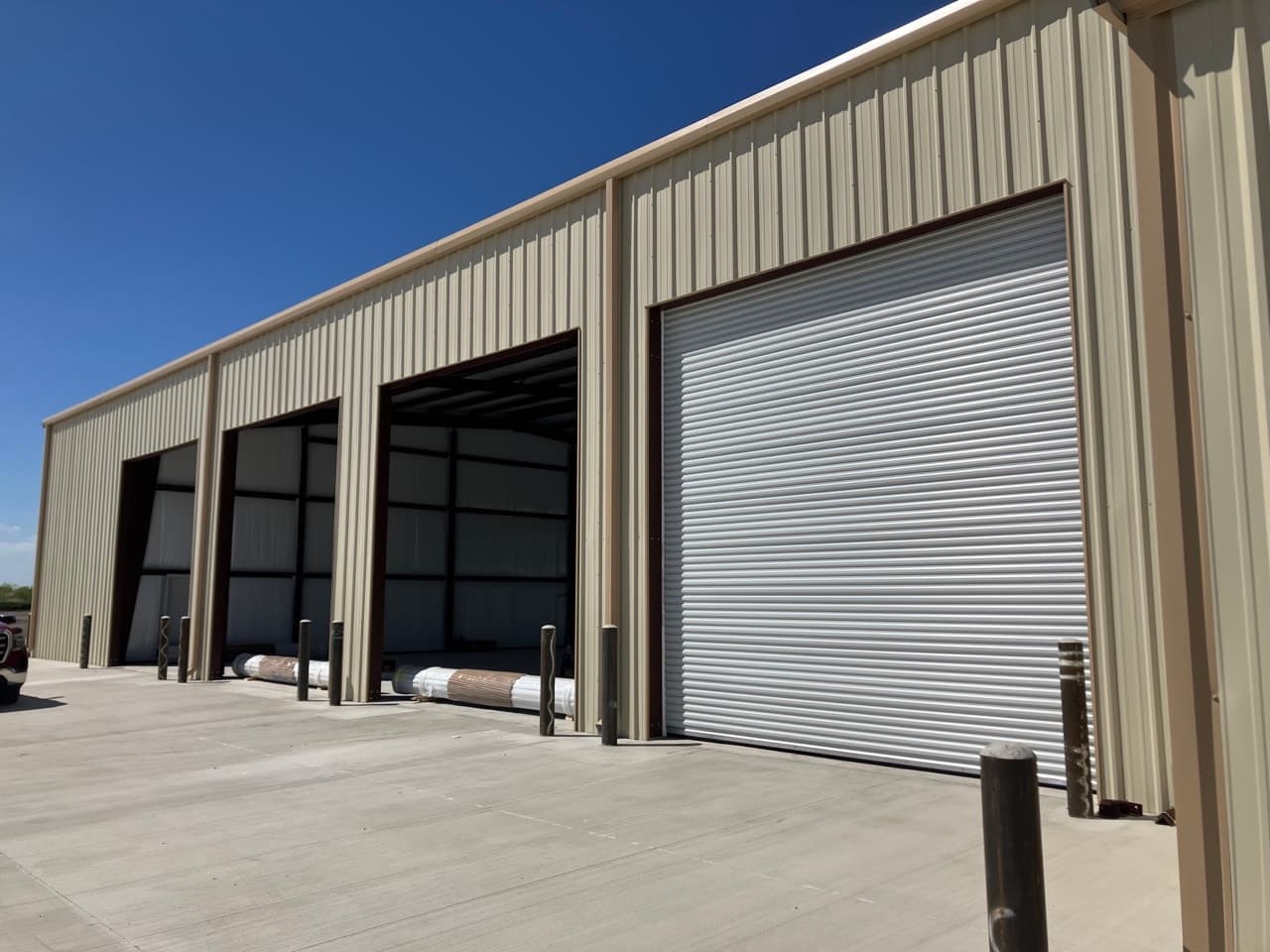
- Rolling steel doors: Interlocking horizontal slats coiled into a barrel above the opening. Excellent security, durability, and tight headroom use. Common in self-storage, retail security, and high-cycle industrial applications.
- High-speed doors: Fabric or steel doors that open and close in 1-3 seconds. Used in environments with high traffic and where temperature, air, or contamination control matters.
- Fire-rated rolling doors: Steel rolling doors that automatically close upon fire alarm signal to maintain fire-rated wall assemblies. Required where openings exceed allowable size in rated walls.
Sectional doors are by far the most common commercial overhead door in Texas warehouses and service bays. Rolling steel doors dominate self-storage and high-security retail. High-speed doors are growing in distribution, food processing, and any environment where door cycles matter.
Commercial Overhead Door Cost Comparison for 2026
The table below shows 2026 installed pricing for common commercial overhead door types in standard sizes. Prices include door, hardware, tracks, and basic operator (where applicable). Pricing varies by manufacturer, insulation R-value, glazing, and complexity.
| Door Type | Typical Size | 2026 Installed Cost | Best For |
|---|---|---|---|
| Non-insulated sectional | 10 x 10 ft | $2,500 - $3,800 | Light warehouse, storage |
| Insulated sectional (R-12) | 10 x 10 ft | $3,500 - $4,800 | Climate-controlled warehouse |
| Insulated sectional (R-18) | 14 x 14 ft | $5,500 - $7,500 | Truck service bays, conditioned space |
| Insulated sectional | 20 x 20 ft | $11,500 - $16,500 | Large equipment bays |
| Rolling steel | 10 x 10 ft | $4,500 - $7,000 | Self-storage, security |
| Rolling steel | 14 x 14 ft | $7,500 - $10,500 | Industrial loading |
| High-speed fabric door | 10 x 10 ft | $8,500 - $14,500 | High-cycle distribution |
| High-speed insulated steel | 12 x 12 ft | $15,500 - $22,000 | Climate control, contamination |
| Fire-rated rolling door | 10 x 10 ft | $12,000 - $18,500 | Rated wall openings |
| Fire-rated rolling door | 16 x 16 ft | $22,000 - $35,000 | Large rated openings |
How Do You Size an Overhead Door for a Warehouse or Service Bay?
Door size affects cost, headroom requirements, and operational efficiency. Common sizing for Texas commercial applications:
- Light warehouse / storage: 8 x 8 to 10 x 10 ft. Sufficient for pickups, small vans, and pallet jacks.
- Loading docks: 8 x 9 or 9 x 10 ft, matched to dock leveler size. Trailer-height openings.
- Drive-through warehouse / cross-dock: 12 x 14 to 14 x 16 ft to accommodate trailer drive-through.
- Class 6-8 truck service bays: 14 x 14 to 16 x 16 ft to fit Class 8 trucks with raised hoods or service lifts.
- Heavy equipment bays: 16 x 16 to 24 x 24 ft for combines, cranes, and oversized equipment.
- Fire trucks and aerials: 14 x 16 to 16 x 18 ft minimum.
Headroom requirements vary by door type. Standard-lift sectional doors need 12-18 inches of headroom above the opening; high-lift and vertical-lift configurations need more but allow trolleys and bridge cranes to operate beneath the open door. SYB Builders coordinates door sizing with the building structural design on every metal building and warehouse project.
What Insulation R-Value Do Texas Overhead Doors Need?
Texas climate makes insulation worth more than most people expect. Insulated sectional doors at R-12 to R-18 are standard for any space that is conditioned or semi-conditioned. Specific recommendations:
- Unconditioned warehouse: Non-insulated or R-6 doors are typically adequate. Skip insulation if the rest of the building isn't insulated.
- Conditioned warehouse with HVAC: R-12 minimum, R-18 strongly preferred for energy efficiency.
- Climate-controlled storage: R-18 minimum, with thermal break frame designs.
- Service bays: R-18 with thermal break, especially in DFW metro where energy code increasingly drives selection.
- Cold storage: R-32+ insulated doors with vapor barrier and integral perimeter heaters.
The 2021 International Energy Conservation Code (IECC) as adopted across most Texas jurisdictions sets minimum overhead door U-values that effectively require R-12 or better on conditioned spaces.
Manual vs Motorized Operation: Which Is Right?
Most commercial overhead doors are motorized in 2026. The cost differential is small relative to operational benefits. As a general rule:
- Doors larger than 10 x 10 ft: Motorize. Manual operation of larger doors is impractical and creates injury risk.
- Doors cycled more than 25 times per day: Motorize regardless of size.
- Doors in conditioned spaces: Motorize to enable timed close and air infiltration control.
- High-cycle distribution doors: Use jackshaft or industrial trolley operators rated for high cycles, not standard residential-grade chain hoists.
Motorized doors require safety controls including photoelectric reversing edges or sensing edges per ANSI/DASMA 102. Plan for monthly safety checks and quarterly preventive maintenance.
What Maintenance Do Commercial Overhead Doors Need?
Overhead doors are mechanical systems with hundreds of cycles between failure modes. Proper maintenance extends life and prevents costly downtime:
- Lubricate hinges, rollers, springs, and chains quarterly
- Inspect torsion springs annually; replace at end of rated cycle life (often 10,000-25,000 cycles)
- Check cables and reverse drums quarterly for wear or fraying
- Test photo eyes and reversing safety devices monthly
- Inspect rollers, hinges, and weather seals annually
- Replace torn or damaged panels promptly to prevent structural failure
A door that goes down on a Monday morning at a truck dealership in Terrell can cost thousands per hour in lost service capacity. Preventive maintenance contracts pay for themselves.
How Do Overhead Doors Integrate with Loading Docks?
Commercial overhead doors at loading docks coordinate with dock levelers, dock seals or shelters, dock bumpers, and dock lights to create a tight, safe loading interface. For Texas commercial warehouse and distribution projects, plan for:
- Door opening sized to match leveler width plus 6 inches typical
- Insulated door with weather seals for energy efficiency
- Vehicle restraint system for trailer safety
- LED dock lights and pull-chain controls
- Bollards on either side of the dock door to prevent vehicle impact damage
For service bay applications, see commercial service bays and equipment for layout and coordination details.
Why Choose SYB Builders for Your Commercial Overhead Door Project?
SYB Builders has installed thousands of commercial overhead doors across truck dealerships, warehouses, service centers, and industrial buildings. Our overhead door capabilities are integrated with our broader metal building and warehouse work, so door selection, opening sizing, and structural design are coordinated from day one. We work with major door manufacturers including Overhead Door, CornellCookson, Wayne Dalton, and Rytec for the right product fit at the right price point. For new construction or service upgrades, request a free estimate or call (903) 560-8330.